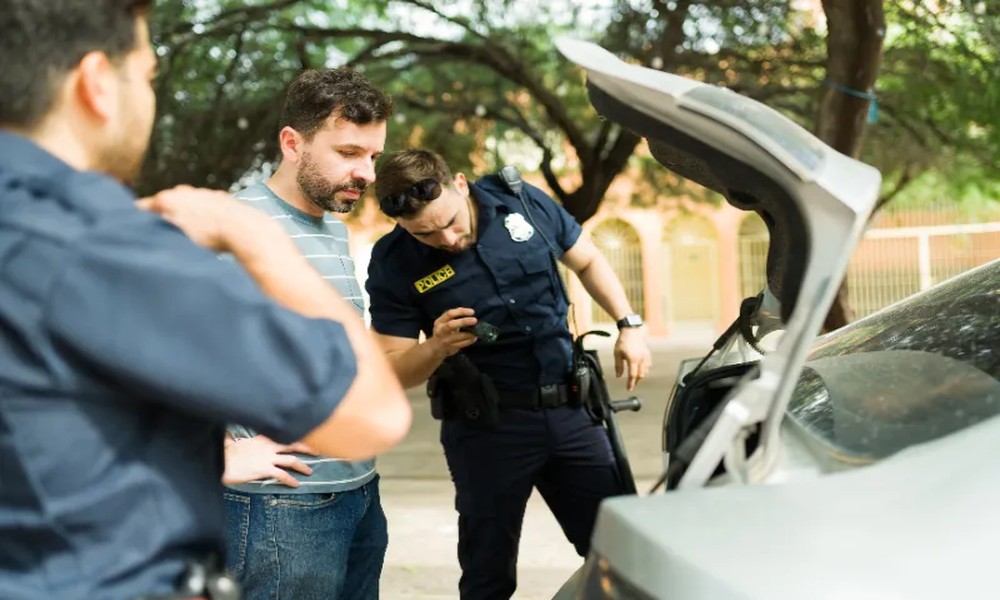
It’s one of the most common questions people have after a traffic stop – and one of the least well understood. Whether officers pulled you over on Highway 101 outside Aberdeen, stopped you in Hoquiam, or approached your vehicle anywhere in Grays Harbor County, knowing what law enforcement can and cannot legally do matters. The Rossback Firm handles criminal defense cases throughout this region, and evidence obtained during vehicle searches is one of the most frequently contested issues in those cases. What follows is a grounded explanation of your rights – not a list of loopholes, but an accurate account of where the law actually draws the line.
The short answer to the question is: sometimes yes, sometimes no, and Washington State law provides stronger protections than federal law in several significant respects.
The Federal Baseline and Why Washington Goes Further
Under the Fourth Amendment to the U.S. Constitution, people are protected against unreasonable searches and seizures. The U.S. Supreme Court has carved out a broad “automobile exception” to the warrant requirement, allowing federal law enforcement – and in many states, local law enforcement – to search a vehicle without a warrant if they have probable cause to believe it contains evidence of a crime or contraband.
Washington State does not follow that exception.
Article I, Section 7 of the Washington State Constitution provides broader privacy protections than its federal counterpart, and the Washington Supreme Court has consistently interpreted those protections to require a warrant for vehicle searches in circumstances where federal law would not. The landmark case is State v. Snapp (2012), in which the Washington Supreme Court explicitly rejected the federal automobile exception and held that law enforcement officers must obtain a warrant before searching a vehicle unless a specific, recognized exception to the warrant requirement applies.
This matters enormously in practice. Evidence obtained in a warrantless vehicle search that violates Article I, Section 7 is suppressible in Washington State court, even if it would have been admissible under federal constitutional standards. For criminal defendants in Grays Harbor County, that distinction can be the difference between a conviction and a dismissal.
When Police Can Search Your Car Without a Warrant in Washington
Rejecting the automobile exception doesn’t mean all warrantless vehicle searches are unlawful in Washington. Several specific exceptions remain valid under both state and federal law.
Consent. If you agree to a search, the officer doesn’t need a warrant. Consent is the most commonly invoked exception and the one most easily avoided. You have the right to refuse. Refusing does not give officers grounds to detain you longer or escalate the encounter on its own. If an officer asks “Do you mind if I take a look?” the legally appropriate response, if you don’t want a search, is: “I do not consent to any searches.” Say it clearly and don’t walk it back.
Search incident to lawful arrest. When you’re lawfully arrested, officers may search the areas within your immediate reach – your person and the area of the vehicle immediately accessible to you at the time of arrest. This exception has been significantly narrowed by the U.S. Supreme Court’s decision in Arizona v. Gant (2009), which held that a vehicle search incident to arrest is only lawful if the arrestee is unsecured and within reaching distance of the vehicle, or if officers reasonably believe the vehicle contains evidence of the offense of arrest. An officer who arrests you for a traffic warrant and then searches your entire vehicle is on shaky constitutional ground under Gant.
Plain view. If an officer is lawfully positioned and observes contraband or evidence of a crime in plain view – visible through the window without any search being conducted – that observation can establish probable cause. But plain view doesn’t automatically authorize a search of areas not visible; it establishes the basis for seeking a warrant or invoking another exception.
Exigent circumstances. If officers have a genuine, objectively reasonable belief that evidence will be destroyed before a warrant can be obtained, or that there is an immediate safety threat, exigent circumstances may justify a warrantless search. Courts scrutinize these claims carefully, and officers cannot manufacture urgency to justify skipping the warrant process.
Inventory searches. When a vehicle is lawfully impounded, officers may conduct a standardized inventory of the contents to document what’s inside before it goes into impound. This is not supposed to be a search for evidence – it’s a procedural protection for both the owner and the department. When inventory searches are used as a pretext for evidentiary searches, courts can and do suppress the results.
What “Probable Cause” Actually Means at a Traffic Stop
Even in states that follow the federal automobile exception, probable cause is the threshold – and it’s higher than many people realize. Probable cause means a reasonable belief, based on specific and articulable facts, that a crime has been committed or that contraband is present. It’s more than a hunch. It’s more than the officer noticing you were nervous. It’s more than the fact that you’re in a high-crime area.
In Washington, where the automobile exception doesn’t apply, probable cause alone is not enough to authorize a warrantless search. Officers who believe they have probable cause should apply for a telephonic or electronic warrant – a process that can be completed in a relatively short time and is now standard practice for Washington law enforcement agencies.
The relevance for anyone stopped by police in Grays Harbor County: if an officer claims to have detected the odor of marijuana and uses that as justification for a warrantless search, the legal analysis in Washington is more complex than in many other states. The Washington Supreme Court has addressed marijuana odor as a basis for probable cause in several cases, and the results are fact-specific. It’s exactly the kind of issue that requires careful examination by a criminal defense attorney after the fact.
Drug-Detection Dogs and Vehicle Searches
A question that comes up frequently: can police bring a drug-detection dog to your car during a routine traffic stop?
Under federal law, a Rodriguez v. United States (2015) decision held that officers cannot extend a traffic stop beyond the time necessary to address the reason for the stop in order to conduct a dog sniff, absent independent reasonable suspicion. The stop has a defined purpose, and once that purpose is completed, the authority to detain you ends.
Washington courts have applied Article I, Section 7 to this issue as well. A dog sniff of the exterior of a vehicle during a lawfully extended stop may not automatically authorize a warrantless search of the interior under Washington’s broader privacy framework, depending on the circumstances. If a search followed a dog alert at a stop in Grays Harbor County, whether that search was constitutional is a question worth examining with an attorney.
What to Do – and Not Do – During a Vehicle Search
If officers ask to search your vehicle, decline clearly and without argument: “I do not consent to any searches.” If they proceed anyway, do not physically resist. Physical resistance to a search, even an unlawful one, creates immediate legal jeopardy that overshadows the constitutional violation. The remedy for an unlawful search is suppression of the evidence in court, not a roadside confrontation.
Document what you can remember as soon as possible after the encounter – the sequence of events, what was said, what the officer claimed as justification. This information becomes the factual record your attorney works with when evaluating whether a suppression motion is viable.
If you weren’t arrested but your vehicle was searched, you still have the right to consult an attorney about whether the search was lawful, particularly if charges are filed later based on what was found.
When Evidence From a Search Can Be Challenged
Suppression motions – formal requests to exclude evidence obtained in violation of your constitutional rights – are a foundational tool in criminal defense. If a court finds that a search of your vehicle violated Article I, Section 7 or the Fourth Amendment, the evidence found in that search generally cannot be used against you at trial. In cases where the search is the primary source of the prosecution’s evidence, a successful suppression motion can result in charges being reduced or dismissed entirely.
The suppression analysis requires looking at the specific facts: what justified the stop, what the officer said and did, what was claimed as the basis for the search, and whether any recognized exception actually applied. This is not a generic analysis – it depends entirely on the details of your specific encounter.
Talking Through What Happened with the Rossback Firm
If you’ve had your vehicle searched by law enforcement in Grays Harbor County and charges have followed, whether the search was constitutionally valid is one of the first questions a criminal defense attorney should examine. The Rossback Firm represents clients in Aberdeen, Hoquiam, Montesano, and throughout the surrounding area who are navigating exactly these situations.
Washington’s stronger privacy protections under Article I, Section 7 give defense attorneys meaningful tools that don’t exist in many other states – but only if those tools are used. Contact the Rossback Firm to discuss the specifics of your case and understand what options are available.